

Nudge, nudge…
...from the desk of Martyn Holland, Integrate's Fundraising Strategist

Politicians more than most, understand the power of words and the importance of choosing them carefully. In launching the Government’s new immigration strategy at the beginning of the week, this was demonstrated by the UK Prime Minister seemingly echoing the tone of Enoch Powell’s infamous 1968 “rivers of blood” speech. These things do not happen by accident in politics, and Starmer’s words were clearly designed to be heard by a particular audience. The right audience one might say.
Also this week I watched a short LinkedIn video by John Amaechi OBE. For those who don’t know him, Amaechi is a Psychologist, Professor of Leadership at University of Exeter Business School, and a specialist in leadership transformation. Prior to this academic career, he was one of the few people raised in the UK to have a successful career in the NBA (US basketball’s equivalent of the Premier League). Amaechi was telling the story of how he came to play basketball.
As a non-sporty, studious, 17 year-old, carrying an armful of library books and a pastry through Manchester, a stranger approached him and said:
“You’d be great at basketball…” Standing at six feet ten tall, Amaechi was used to strangers making comments. But not in this way.
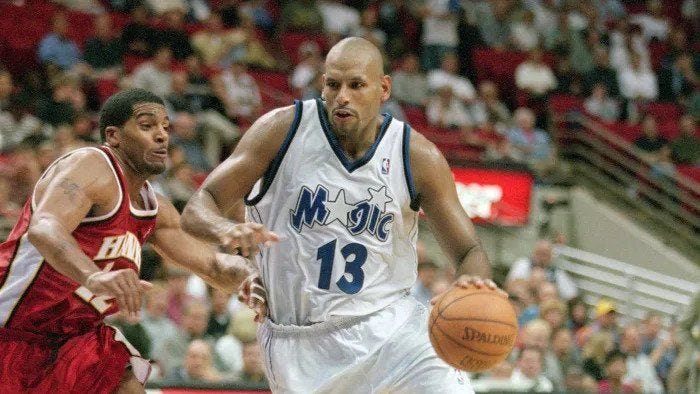
John Amaechi in action for the Orlando Magic in he NBA
That moment, that phrase, in fact, one word changed his life. If that stranger had said “would you like to play basketball?” Amaechi insists he would have said no and stuck to enjoying pastries and books. But for John it was the first time he could remember anyone outside of his parents, telling him he would be great at anything. He took note and days later had a basketball in his hands for the first time.
Fundraisers, are painfully aware of the power of words. Those of us who write to raise funds think about words every bit as deeply as poets (probably). We writhe in paroxysms of agony attempting to establish a definitive tone, searching for the sweet spot between persuasion and panic (or as in this sentence, simply abusing the thesaurus).
There are certain tactics that we deploy in order to make our writing effective and compelling. We try to tell ‘human’ stories that resonate with the readers’ emotions, often distilling the work we are describing into a case study. And of course, when I say ‘human’ stories I have to acknowledge that some of the most effective and emotional fundraising is done by animal charities. We attempt to convey the urgency of a situation, the scale of your donation’s impact, and the momentum that is gathering for the cause.
I read a great deal of praise this week for the premier of the new David Attenborough film, Ocean. I read countless reports of its beauty and its inspirational message. But one critique that stood out to me was from a committed ocean advocate, Luke McMillan. The gist of his response was that the film was TOO hopeful and lacked the necessary urgency to be truly inspiring. He felt the call to action had been lost amidst the hope. It left him with a hollow feeling that, because there is hope and that we are saving the oceans, the necessary actions must already be in safe hands. So, as a viewer, do I have a role to play?
I confess that I have not seen the film, and perhaps this is the opinion of an outlier an opinion based more on his expert knowledge of the situation. This reaction demonstrates the difficulty or impossibility of choosing words that impact the same on everyone. The thought must focus not only on the words, but who will read them. The example of Ocean to me suggests that the film’s messaging is hitting the target. That is to say, those people who are not experts and who will still hear the call to action wrapped in this hopeful and visually spectacular package. I can only assume that this was the plan.
As you will know if you have read my previous pieces, I am currently involved in schooling young people in the dark arts of fundraising. I am at pains to emphasise to them the importance of research in fundraising. I have rarely sent out a fundraising application without considering the trustees who might be reading it. I cannot always claim I find out a great deal about them, but I do try. I may recognise a name on the board. I may see the names of other organisations’ boards that they sit on. I may read something of their career, their political affiliation or their religion. All of this has the potential to feed into the words I choose, or the tone I try to create.
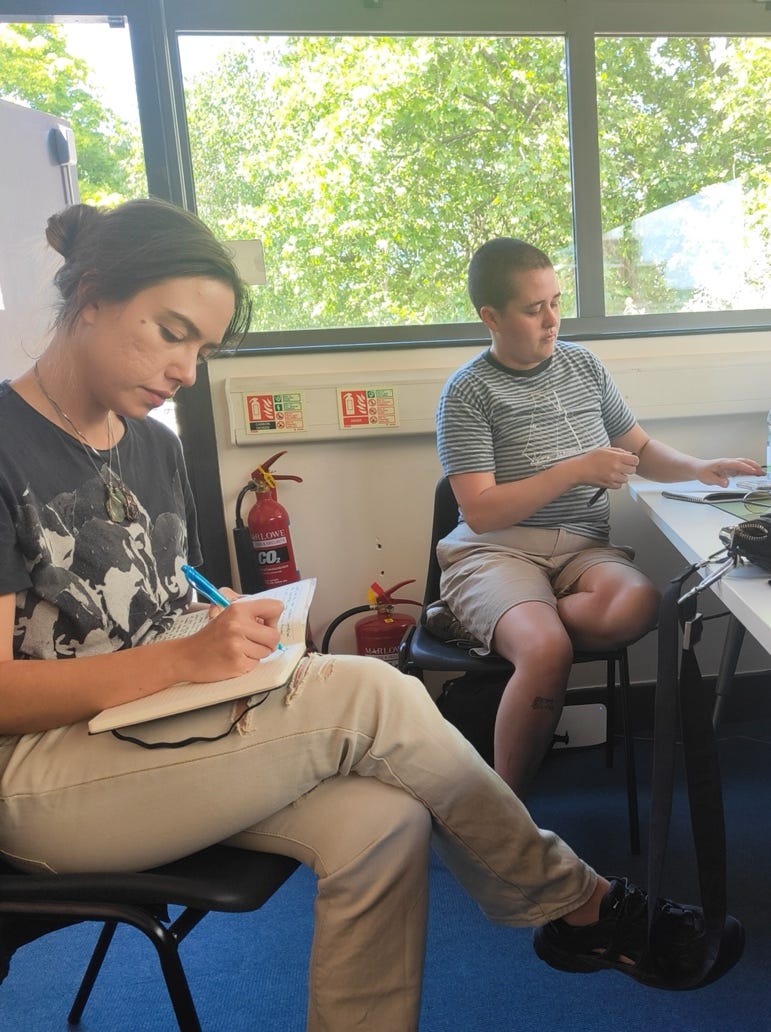
Future Fundraisers choosing their words carefully…
It is not science. It is often a gut-feeling. A hunch. And the most frustrating thing about it is that whether I get a positive result or not, I am unlikely to ever know exactly what it was that made the difference. And even if I do find out what tipped things in my favour, how likely is it that it will have the same impact on another funder?
Around the start of the 2010s governments, marketeers and other organisations interested in decision-making, became fascinated by nudge theory. Nudge theory is a concept that spans the disciplines of psychology, economics, consumer theory and other branches of behavioural science. It looks at the subtle changes that can be made to words we use or to the environment we create, that can influence behaviour in a predictable way. Think, placing sweets at a child’s-eye-level near the checkouts in supermarkets.
Academics, Richard Thaler and Cass Sunstein wrote the bible of nudge theory, and have certainly had an influence on fundraisers’ practices in the pursuit of persuasion. Donation forms highlighting regular donations and making the one-off gift option harder to locate. Manipulating suggested donation amounts on forms to increase the average donation – in particular starting with the highest and working down. Using a time limited period that a donation can be ‘matched’ to increase the urgency of donations. These things are classic ‘nudges’.
For my work, which has principally been in trust fundraising, finding an amalgam of all these principles is the goal. Writing persuasive copy that resonates with the reader’s emotions: creating a tone that inspires action while holding onto the hope of a positive outcome; forming the architecture of what I write to nudge people in the right direction. These are the things I’m striving for when I am staring at a blank page with a furrowed brow. As John Amaechi’s story shows, all I need to do is simply choose the right words.
John Amaechi on LinkedIn: https://www.linkedin.com/in/amaechi/
Luke McMillan on LinkedIn: https://www.linkedin.com/in/lukedmcmillan/
Nudge: Improving Decisions About Health, Wealth and Happiness. Richard H. Thaler and Cass R Sunstein. ISBN-10 : 0141040017
Ocean with David Attenborough: https://www.oceanfilm.net